Notebooks & Journals
Notebook Types, and What Each Binding Is Actually For
Size and ruling get all the attention. Binding is the third axis, it is the one that decides whether a page can leave the book, and almost nobody explains it.
How this page is funded. Buying through a link here earns us a commission at no extra cost to you. It does not change what we recommend or the order we recommend it in, and we have not handled these products ourselves — see how we pick and the full disclosure.
A notebook is chosen on three things and most people only ever consider two. Size is obvious and we have a page on it. Ruling is visible on the shelf and we have a page on that too. Binding is the third, it is the one nobody photographs, and it decides more about how the book behaves than either of the others.
Specifically it decides two things: whether the book will lie flat while you write in it, and whether a page can come out without wrecking the rest. Everything below is organized around those two questions.
The six constructions at a glance
| Type | Lies flat | Pages come out | Best at | Weakness |
|---|---|---|---|---|
| Sewn / thread-bound | Yes, from page one | No - removing one loosens its pair | A book you keep | Cannot be reorganized or added to |
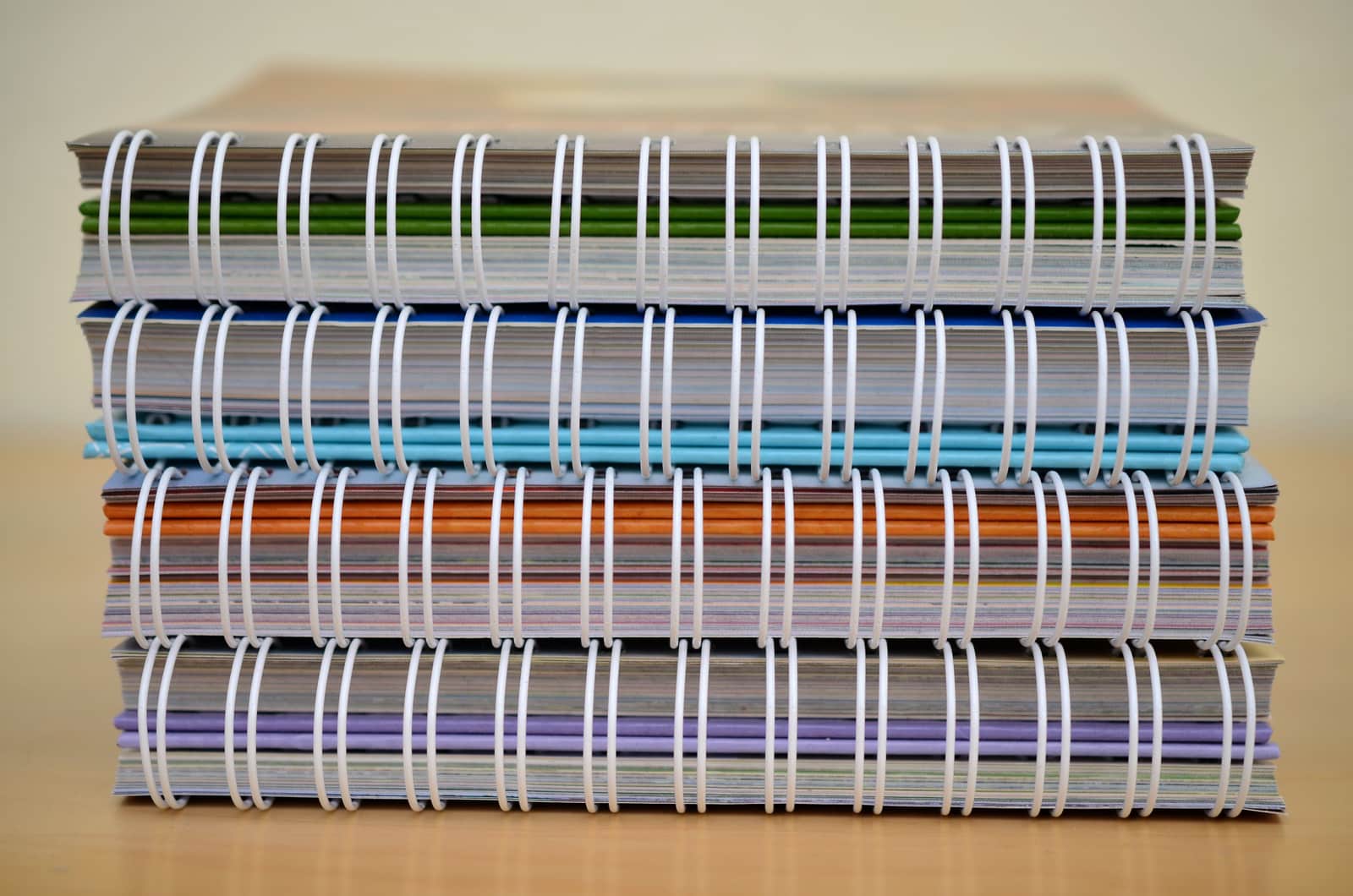
| Spiral / wire, side-bound | Yes, and folds back on itself | Yes, cleanly | Working notes, small desks | Wire snags and bends; hand rests on it |
| Saddle-stitched | Not when new | Yes, but the facing sheet comes too | Thin pocket books | Staples fail if soaked; low page count |
| Discbound | Yes | Yes, and they go back in anywhere | Notes you reorder later | Bulky; costs more per page |
| Top-bound pad | Rigid back, needs no desk | Yes, micro-perforated | Writing standing up | Nothing keeps the removed sheets in order |
| Refillable cover | Depends on the insert | You swap the whole insert | A cover that outlives the paper | Only as good as the insert you buy |
Quick picks
Ranked for the person doing the buying. Every pick names who it is wrong for.
| # | Product | Best for | Price |
|---|---|---|---|
| 1 | No image LEUCHTTURM1917 Medium A5 Dotted Hardcover Notebook 80 gsm paper, 251 numbered pages and a printed contents page, which is why this is the default recommendation in every journaling forum. | The bullet-journal standard | Check price on Amazon #ad No live price right now. How this is funded |
| 2 | No image Rhodia Spiral Notebook, A5+, Ruled A side-spiral book on 80 gsm Clairefontaine with 160 detachable pages, which is the construction to buy when the page has to leave the book. | Pages you intend to remove | Check price on Amazon #ad No live price right now. How this is funded |
| 3 | No image Field Notes Original Kraft 3-Pack, Ruled Three 48-page memo books on 90 gsm acid-free stock - the only pocket notebook here that states a paper weight at all. | A pocket book that publishes its paper | Check price on Amazon #ad No live price right now. How this is funded |
| 4 | No image TUL Discbound Notebook, Junior Size, Leather Cover Eight discs instead of a spine, so pages come out and go back in anywhere - the only construction here that lets you rearrange a finished notebook. | Reordering pages after you have written them | Check price on Amazon #ad No live price right now. How this is funded |
| 5 | No image Rhodia Wirebound Notepad, A5, Dot Top-wirebound with micro-perforated sheets and a rigid back, which makes it the one on this page you can write on standing up. | A pad, not a notebook | Check price on Amazon #ad No live price right now. How this is funded |
| 6 | No image Leather Journal Gift Set with Metal Pen, A5 Refillable A refillable leather cover, a metal pen and a black gift box, and it takes standard A5 inserts so it outlives the notebook inside it. | A gift that arrives finished | Check price on Amazon #ad No live price right now. How this is funded |
1. The bullet-journal standard
LEUCHTTURM1917 Medium A5 Dotted Hardcover Notebook
80 gsm paper, 251 numbered pages and a printed contents page, which is why this is the default recommendation in every journaling forum.
#ad No live price right now. How this is funded
Numbered pages plus a printed contents page is the whole reason bullet journaling settled on this book. An index needs page numbers, and printing them saves the user writing 251 of them.
80 gsm against the Moleskine Classic's published 70 gsm is a 14 percent difference in paper weight, and it is the difference most people notice as ghosting on the reverse of a page.
Two ribbons is not decoration in a journal that has an index. One marks the index, one marks today.
| Paper weight | 80 gsmSource: Amazon listing - LEUCHTTURM1917 Notebook Hardcover Medium A5, Dotted |
|---|---|
| Pages | 251 numbered pages, with 8 perforated detachable sheetsSource: Amazon listing - LEUCHTTURM1917 Notebook Hardcover Medium A5, Dotted |
| Size | A5, approximately 5.75" x 8.25" (145 x 210 mm)Source: Amazon listing - LEUCHTTURM1917 Notebook Hardcover Medium A5, Dotted |
| Fittings | Blank table of contents, two page markers, gusseted rear pocket, elastic band, archival stickersSource: Amazon listing - LEUCHTTURM1917 Notebook Hardcover Medium A5, Dotted |
| Binding | Thread bound, opens flatSource: Amazon listing - LEUCHTTURM1917 Notebook Hardcover Medium A5, Dotted |
What it does well
- 251 pre-numbered pages and a blank contents page, ready for an index.
- 80 gsm published, the heaviest of the three mainstream hardcovers here.
- Thread bound, so it lies flat from the first page.
What it does not
- Still not fountain-pen-proof; 80 gsm reduces show-through, it does not eliminate it.
- The dot grid is fainter than some users want for straight-line work.
Skip this: if the recipient has never mentioned journaling. A 251-page dotted notebook handed to a non-journaler is 251 blank pages of obligation. See how to pick a journal as a gift.
2. Pages you intend to remove
Rhodia Spiral Notebook, A5+, Ruled
A side-spiral book on 80 gsm Clairefontaine with 160 detachable pages, which is the construction to buy when the page has to leave the book.
#ad No live price right now. How this is funded
Spiral binding does two things a sewn book cannot: it opens completely flat from the first page, and it folds back on itself so the book takes half the desk. On a small desk or a train table that is the whole argument.
Detachable pages are the other half. A sewn notebook punishes you for removing anything - the facing page loosens and eventually falls out. A spiral book is designed to give pages up, which is why it suits meeting notes you hand over and drafts you file.
The cost is the spiral itself. It catches on bag linings, it flattens if the book is dropped on the wire, and writing on the left-hand page means your hand rests on metal.
| Binding | Spiral, full binding, side boundOpens fully flat and folds back on itself, which no sewn hardcover does.Source: Amazon listing - Rhodia Spiral Notebook A5+ |
|---|---|
| Paper | Clairefontaine 80 g/m2Source: Amazon listing - Rhodia Spiral Notebook A5+ |
| Pages | 160, detachableSource: Amazon listing - Rhodia Spiral Notebook A5+ |
| Size | A5+Slightly larger than standard A5, which is worth knowing if it has to fit a sleeve.Source: Amazon listing - Rhodia Spiral Notebook A5+ |
| Cover | Soft, resistant coated cardSource: Amazon listing - Rhodia Spiral Notebook A5+ |
What it does well
- Opens flat from page one and folds back on itself.
- 160 detachable pages on published 80 gsm Clairefontaine stock.
- Coated card cover shrugs off desk wear better than plain card.
What it does not
- The wire snags in a bag and bends if the book is dropped on it.
- A left-handed writer rests a hand on the spiral on every right-hand page.
- A5+ rather than true A5, so sleeves and covers sized for A5 will not fit.
Skip this: if the notebook is a keepsake. Spiral bindings are working bindings - they are built to give pages up and to be replaced, not to sit on a shelf for twenty years.
3. A pocket book that publishes its paper
Field Notes Original Kraft 3-Pack, Ruled
Three 48-page memo books on 90 gsm acid-free stock - the only pocket notebook here that states a paper weight at all.
#ad No live price right now. How this is funded
Ninety gsm in a pocket notebook is genuinely unusual and it is the entire reason this is the first pick. Pocket books are normally where paper quality goes to die - thin stock, because nobody expects to check. This one publishes the same weight class as the site's top full-size recommendation.
Forty-eight pages per book sounds slight and is the correct size for the format. A pocket notebook is a capture device; it gets filled in a few weeks and replaced, which is why they are sold in threes.
Acid-free matters more here than the page count. These are the notes you transcribe later, and a saddle-stitched book that yellows in a drawer defeats the purpose of having captured anything.
| Paper weight | 60 lb (90 gsm) Finch Opaque, acid freeThe same weight class as the Rhodia Webnotebook, in a book a fraction of the size.Source: Amazon listing - Field Notes Original Kraft 3-Pack |
|---|---|
| Size | 3.5" x 5.5"Source: Amazon listing - Field Notes Original Kraft 3-Pack |
| Pages | 48 per book, ruledThree books in the pack, so 144 pages in total.Source: Amazon listing - Field Notes Original Kraft 3-Pack |
| Printing | Soy-based inkSource: Amazon listing - Field Notes Original Kraft 3-Pack |
What it does well
- 90 gsm published, which no other pocket notebook in this comparison states.
- Acid-free, so a filled book survives being kept.
- Three to a pack, which matches how the format is actually used.
What it does not
- 48 pages goes fast if you write more than a few lines a day.
- Ruled only in this pack - no dot grid option here.
- Saddle-stitched rather than bound, so it will not lie flat when new.
Skip this: if what you want is one book that lasts a year. This is a consumable bought three at a time, and somebody expecting a single durable journal will find it slight. Buy an A5 hardcover instead - see notebooks for writers.
4. Reordering pages after you have written them
TUL Discbound Notebook, Junior Size, Leather Cover
Eight discs instead of a spine, so pages come out and go back in anywhere - the only construction here that lets you rearrange a finished notebook.
#ad No live price right now. How this is funded
Discbound is the one construction on this page that solves a problem after the fact. Every other notebook fixes the page order when it is manufactured; a disc system lets you pull page 40 out and put it behind page 12 a month later, with no tools and no punch holes tearing.
That makes it the format for anything that gets reorganized - project notes that turn into sections, meeting notes that get filed by client, a planner that needs this month at the front. It is also why it is sold as a system rather than a book: tabs, dividers and refills are the point.
The trade is bulk and cost per page. Eight discs sit proud of the spine so it never lies as flat in a bag as a sewn book, and refills bought over time cost more than the same paper in a bound notebook.
| Binding | Discbound, 8 discsPunched pages slide on and off the discs without tools.Source: Amazon listing - TUL Custom Note-Taking System Discbound Notebook, Junior Size |
|---|---|
| Size | Junior, 5.5" x 8.5"Source: Amazon listing - TUL Custom Note-Taking System Discbound Refill Pages, Junior Size |
| Sheets included | 60, narrow ruledSource: Amazon listing - TUL Custom Note-Taking System Discbound Notebook, Junior Size |
| Refills | Refill pages, tabs, dividers and task pads available separatelySource: Amazon listing - TUL Custom Note-Taking System Discbound Notebook, Junior Size |
| Fittings | Built-in pen loop and business card holderSource: Amazon listing - TUL Custom Note-Taking System Discbound Notebook, Junior Size |
| Paper weight | Not publishedNot stated on either the notebook or the refill listing. For a system sold on customization that is a real gap if you write with anything wet. |
What it does well
- Pages come out and go back in anywhere, without tools.
- Refills, tabs and dividers make it a system rather than a fixed book.
- Pen loop and card holder are built in rather than accessories.
What it does not
- No published paper weight on either the notebook or the refills.
- The discs add bulk and stop it sitting flat in a bag.
- Refills over time cost more per page than a bound notebook.
- Pages can pull off the discs if the book is yanked from a bag by one cover.
Skip this: if you never reorder anything. The entire premium goes on rearranging pages, and if your notes stay in the sequence you wrote them, a sewn notebook is cheaper, flatter and holds more.
5. A pad, not a notebook
Rhodia Wirebound Notepad, A5, Dot
Top-wirebound with micro-perforated sheets and a rigid back, which makes it the one on this page you can write on standing up.
#ad No live price right now. How this is funded
A top-bound pad is a genuinely different object from a side-bound notebook and the difference is where you can use it. The rigid back means it supports itself, so it works on a knee, in a corridor or standing at a bench - which is the same reason clipboards exist.
Micro-perforation is the detail that separates a pad from a notebook with a spiral. The sheet comes away along a clean line rather than a torn edge, so a page handed to somebody else does not look ripped out.
Eighty sheets is not many, and that is correct for the format. A pad is a consumable that gets torn down and replaced, not a book you archive.
| Binding | Wirebound at the top edgeA pad rather than a book - sheets flip up and over rather than turning sideways.Source: Amazon listing - Rhodia Wirebound Notepad, A5, Dot |
|---|---|
| Paper | Clairefontaine 80 g superfine vellumSource: Amazon listing - Rhodia Wirebound Notepad, A5, Dot |
| Sheets | 80, detachable and micro-perforatedSource: Amazon listing - Rhodia Wirebound Notepad, A5, Dot |
| Backing | Ultra rigid back boardThis is what lets it be used without a desk under it.Source: Amazon listing - Rhodia Wirebound Notepad, A5, Dot |
What it does well
- Rigid back means it works with no desk under it.
- Micro-perforated sheets tear off clean rather than ragged.
- Published 80 g Clairefontaine vellum, the same stock class as the brand's notebooks.
What it does not
- Eighty sheets goes quickly if you are not tearing them off.
- A top wire means your hand rests on it at the top of every page.
- Nothing holds the removed sheets - it is a pad, so filing is your problem.
Skip this: if you want to keep what you write in order. A pad is designed to be dismantled; if the notes need to stay bound and in sequence, buy a sewn or spiral notebook instead.
6. A gift that arrives finished
Leather Journal Gift Set with Metal Pen, A5 Refillable
A refillable leather cover, a metal pen and a black gift box, and it takes standard A5 inserts so it outlives the notebook inside it.
#ad No live price right now. How this is funded
Refill compatibility is the whole argument for a leather cover. Because it takes a Leuchtturm1917 or a Moleskine insert, a buyer who later learns the recipient's paper preference can fix it for the price of a notebook rather than the price of the set.
The supplied insert's paper weight is not published, which is the standard weak point of gift sets. Treat the insert as a starter and the cover as the gift.
Initials change the arithmetic of a gift. An embossed cover cannot be regifted, which is a cost, and it cannot be mistaken for something bought in a hurry, which is the point.
| Refill compatibility | Takes A5 inserts including LEUCHTTURM1917, Moleskine and Panda PlannerThis is the specification that matters. A cover locked to a proprietary insert becomes landfill when the maker stops making them.Source: Amazon listing - Personalized Leather Journal Gift Set |
|---|---|
| Included | Leather cover, A5 lined paper notebook, metal pen with black gel ink, black gift boxSource: Amazon listing - Personalized Leather Journal Gift Set |
| Personalization | Initials embossed on the coverSource: Amazon listing - Personalized Leather Journal Gift Set |
| Paper weight of the supplied insert | Not publishedNot stated. If the recipient uses a fountain pen, plan on replacing the insert with a known-weight notebook - which this cover is designed to accept. |
What it does well
- Accepts standard A5 inserts, so the cover outlasts any one notebook.
- Arrives boxed with a pen, so it is a complete present with nothing to add.
- Personalization available without a separate engraving service.
What it does not
- The supplied insert has no published paper weight.
- Embossed initials make it non-returnable and non-regiftable.
Skip this: if you are not certain of the spelling of their name or their initials. An embossing error is not fixable and not returnable.
Sewn is the default for a reason
Thread-bound - sometimes called section-sewn or Smyth-sewn - stitches folded groups of pages together and glues the whole block into the cover. It is why a good hardcover opens flat on page three and still opens flat on page two hundred, and it is why those books survive being carried for years.
The trade is permanence. The page order is decided at the factory and you cannot change it, and pulling a sheet out loosens the one it was folded with, which will eventually fall out on its own. If your notes are a record, that permanence is the feature. If they are a working document, it is the problem.
Watch for the cheaper alternative that looks identical on a shelf: perfect binding, where loose sheets are simply glued at the spine. It is what most cheap notebooks use, it does not lie flat, and pages fall out of it as the glue ages. Nothing on the listing usually tells you which you are getting - a book that opens flat in the shop is sewn.
Spiral and wire: the working bindings
A side-bound spiral does the two things a sewn book cannot. It opens completely flat immediately, and it folds back on itself so the open book takes half the desk it otherwise would. On a train table, a lecture hall flip-up desk or a small desk, that halving is not a nicety - it is the difference between usable and not.
It also gives pages up willingly. A spiral book is built for sheets to be removed, which is why it suits notes you hand over and drafts you file. The costs are physical and predictable: the wire catches on bag linings, it deforms permanently if the book lands on it, and on right-hand pages your writing hand rests on metal - a real irritation for left-handed writers on every left page.
Saddle-stitch, and why thin books use it
Folded sheets stapled through the spine. It is the cheapest real binding, it is why pocket notebooks cost what they do, and it is why they survive being folded into a back pocket without the spine cracking.
Two limits follow from the construction. It only works up to a modest page count - stack too many folded sheets and the inner pages jut out past the outer ones. And removing a sheet takes its other half with it, because they are the same piece of paper folded in the middle. Pocket notebooks goes into the format properly.
Discbound is the one that solves a problem later
This is the construction most people have never used and the one with a genuinely distinct capability. Pages are punched with a mushroom-shaped cutout that slides on and off a row of discs, so you can pull page 40 out and put it behind page 12 a month after writing it, with no tools and no ring binder bulk.
Every other binding here fixes the page order permanently at manufacture. Only this one lets you reorganize a notebook you have already filled, which is why it is sold as a system with tabs, dividers and refills rather than as a book.
The honest costs: the discs sit proud of the spine so it never packs as flat as a sewn book, refills bought over time cost more per page than a bound notebook, and pages can pull free if the book is dragged out of a bag by one cover.
Top-bound pads are not notebooks
Worth separating out because they get shelved alongside notebooks and behave completely differently. A pad is wire-bound along the top edge with a rigid back board, so it supports itself - you can write on it on a knee, in a corridor or standing at a bench, which is the same reason clipboards exist.
Micro-perforation is the detail that distinguishes a good pad. The sheet separates along a clean line instead of a torn edge, so a page handed to somebody does not look ripped out. The flip side is that nothing keeps the removed sheets in order once they are off - filing is entirely your problem.
Refillable covers are a different kind of decision
A refillable leather cover is not really a binding at all - it is a jacket that holds somebody else's binding. Which means the only specification that matters is what it accepts. A cover that takes standard A5 inserts can be restocked from any stationery shelf indefinitely; one locked to a proprietary refill becomes an empty object the day that refill is discontinued.
The good ones say so explicitly. Our top journal set names Leuchtturm1917, Moleskine and Panda Planner as compatible inserts, which is exactly the statement worth looking for and exactly the thing product photography cannot tell you. Journal gift sets works through the rest.
Choosing, in one question
- Will you keep it? Sewn hardcover.
- Will you tear pages out? Spiral, or a top-bound pad if you want them perforated.
- Will you reorder it later? Discbound, and nothing else does this.
- Will you carry it in a pocket? Saddle-stitched, and accept the page count.
- Do you want the cover to outlive the paper? A refillable cover, checked for what it accepts.
- Writing standing up or on a knee? A rigid-backed pad.
Questions people actually ask
What are the different types of notebook binding?
The six you will actually meet: sewn or thread-bound, side-bound spiral or wire, saddle-stitched, discbound, top-bound pads, and refillable covers that hold somebody else's insert.
Which notebook binding lies flat?
Sewn hardcovers lie flat from page one, and spiral books do too while also folding back on themselves. Saddle-stitched books need bending open first, and cheap perfect-bound notebooks never really lie flat at all.
What is discbound and is it worth it?
Punched pages slide on and off a row of discs, so you can reorder a notebook after writing it. It is the only construction that allows that, and worth it only if you actually reorganize your notes.
What is the difference between a notepad and a notebook?
A pad is wire-bound at the top with a rigid back, so it supports itself and sheets are meant to be torn off. A notebook is side-bound and meant to stay intact and in sequence.
What is perfect binding and should I avoid it?
Loose sheets glued at the spine, used by most cheap notebooks. It looks like a sewn book on the shelf, does not lie flat, and sheds pages as the glue ages. A book that opens flat in the shop is sewn.
Which binding is best for left-handed writers?
Sewn or a refillable cover. On a side-bound spiral the writing hand rests on the wire on every left-hand page, which is the most common left-handed complaint about the format.